
Physalia utriculus
Bluebottle
Tū-pakipaki-tai RR
f.PHYSALIIDAE
No EngFamily
Physalia utriculus
Bluebottle
Tū-pakipaki-tai RR
f.PHYSALIIDAE
No EngFamily
Cook Islands Status Summary
Show Notes
Intl. NamesBluebottle EN Pacific Portuguese Man‑of‑war EN
Local NamesTū-pakipaki-taiRR Tutae TōrāAT KākāMK,MT Tūtae To‘orāAK PakipakiTNs,TNw
Pacific NamesNo Content
Sci. NamesPhysalia utriculus (accepted name)
, Physalia physalia
High Tax. Eng.k.Animals, p.Cnidarians, c.Hydrozoans - Pseudo-Jellyfish
High Tax. Latink.ANIMALIA, p.CNIDARIA, c.HYDROZOA, o.Siphonophora, f.PHYSALIIDAE
Natl. PresencePresentOceanicP
Sth. PresenceRR++MG?ATPMKPMT?AK?PL?MN?TK?
Nth. PresenceTN?MH?RK?PK?NS?SW?
VouchersRR2004
Local OriginNative; Resident
Global RangeNative: Indian Ocean - Pacific Ocean;
HabitatAquatic; Marine; Nearshore; Oceanic
ThreatenedNo Content
InvasivenessNo Content
BiosecurityNo Content
Medical StatusNo Content
Harmful StatusHarmful - serious; injects venom
UsesNo Content
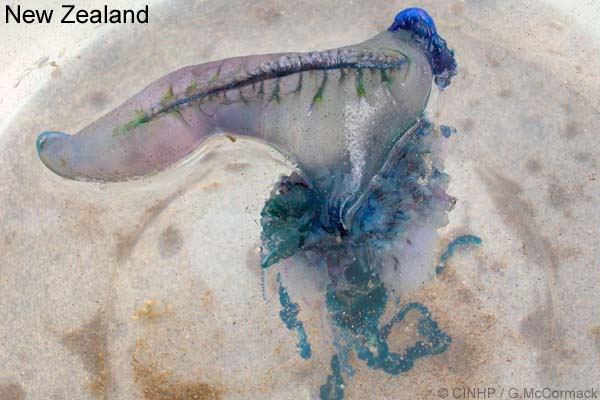
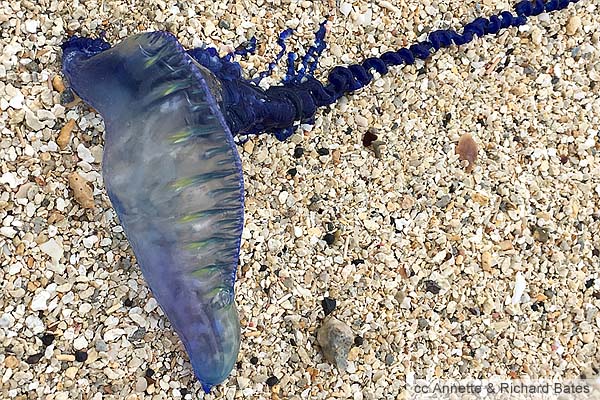
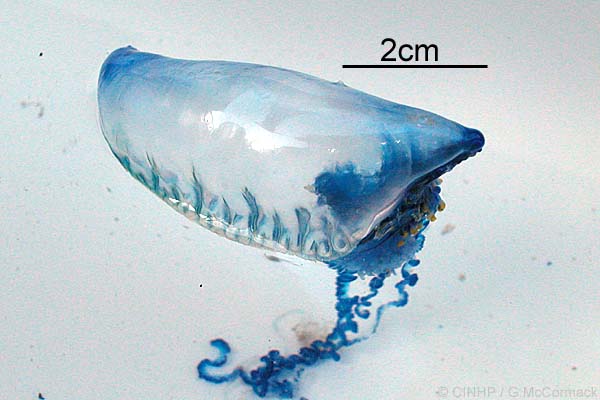
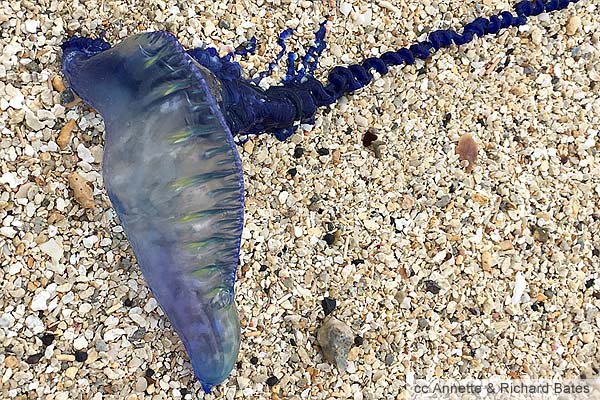
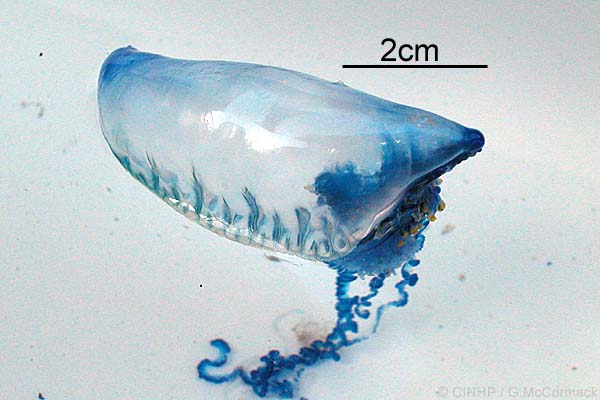
IdentificationAn oval, gas-filled float, to 10cm long, with blue markings. Underneath is a cluster of short tentacles, with a single very long tentacle (to several metres). All tentacles sting for defence or to capture prey. The stinging cells (=cnidoblasts) have more...a use-once, stinging capsule (=nematocyst) that shoots out a hollow tube to inject toxins.
The Bluebottle is a cluster of individuals (=polyps): one forms the float, many form tube-like feeding parts (=gastrozooids), many bud separate male and female medusae (=gonozooids), and one forms the "fishing line" (=dactylozooid). When small fish touch the "fishing line" they are stung and paralysed with poison and the line contacts to bring the victim up so the shorter gastrozooid mouths can get into action.
The Bluebottle is a cluster of individuals (=polyps): one forms the float, many form tube-like feeding parts (=gastrozooids), many bud separate male and female medusae (=gonozooids), and one forms the "fishing line" (=dactylozooid). When small fish touch the "fishing line" they are stung and paralysed with poison and the line contacts to bring the victim up so the shorter gastrozooid mouths can get into action.
Similar SpeciesPhysalia physalia, the Portuguese Man-o'-war, is mainly an Amore...tlantic species, with a float to 25cm long (vs. 10cm), and numerous contractile "fishing-lines" (vs. a single line).
Interest NoteThe "fishing line" has powerful stinging cells which can infmore...lict a very painful sting, and stinging cells can continue to discharge for a long time. TREATMENT: immediately lift off "fishing-line" with clothing, and apply vinegar (3% acetic acid). Removing the thread stops further injections of poison, and the vinegar inhibits stinging-cell activity. DO NOT use methylated spirits, alcohol, human urine or freshwater as these increase the activity of stinging-cells, and vinegar (apparently) increases nematocyst discharge for Physalia physalia. After the initial treatment the injured skin can be treated with ointments, antihistamines or even meat tenderizer (papain). The toxins are proteins, which act on the nervous system. In severe cases, where headaches, nausea, collapse etc occur, seek immediate medical assistance. Deaths have not been substantiated, although the extreme pain, or an extreme reaction to the toxin, may lead to drowning.
Show All Notes
Multimedia & Other Resources
Click on a thumbnail to see the full image and image details.
Vernacular Names
no data available
Threatened
no data available
Biosecurity
no data available
Species Uses
Citation Information
McCormack, Gerald (2026) Cook Islands Biodiversity & Ethnobiology Database, Version 2026.07.12 - Cook Islands Natural Heritage Trust, Rarotonga. Online at https://naturalheritage.gov.ck/cibed
Please refer to our use policy.
Saved Species
X of 20
- Save Species